Explore Religious Heritage Across Europe

Here you can search for a building to visit. You can use the map find destinations, or you can use the filters to search for a building based upon what different criteria.

Refine search

Reformed Church

Dorkwerd, NL

Historic church with tower. Restoration 2008. The reformed community of the small village of Dorkwerd is part of the Protestant Church in the Netherlands (PKN).

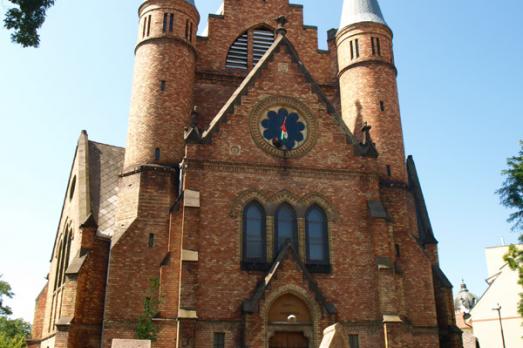
Reformed Church, Szombathely

Reformed Church, Szombathely

Szombathely, HU

The Reformed Church was completed in 1939 and consecrated the same year by Bishop Vince Medgyasszay. The interior paintings of the church were made by Ilona Biczó and her husband. They contain biblical motifs, mixed with elements of Hungarian folk painting. The church survived the bombings of World War II unscathed, but underwent a major renovation in 1988. Its two-manual electric organ was built by Albert Péter.

Reformed church

Loenen, NL

Built in 1861 to replace the old village church. Three copper chandeliers, Louis XVI. Tombstone, 17th century. Single manual organ of Westphalian origin. Made around 1700. Placed in the Herv. Church in Loenen in 1870. On that occasion, the lower case was removed and the keyboard moved to the side. During the restoration in 1978, the case was reconstructed in its original form (with lower case and backside playing). The maker of the organ is unknown.

Reformed church

Lieren, NL

Extension at the rear and modification of the roof turret.

Reformed church

Sprang, NL

Reformed Church. Late Gothic church, consisting of a three-sided closed choir from around 1400, a three-sided closed southern transept from the beginning of the 15th century, a straight-closed northern transept from the middle of the 15th century; a three-aisled nave of which the three eastern bays are from the same period and of the same style as the choir, the three western bays are higher and wider, belong to a new building plan from the end of the 15th century, as does the west tower.

Reformed church

Rotterdam, NL

Built as a Reformed Church (Liberated) in the IJsselmonde district. Now in use (since when?) by Jehovah's Witnesses. Between 2014 and 2019, the Jehovah's Witnesses left this building. Today, the building is used as a mosque.

Reformed Church

Krommeniedijk, NL

Since 1968, the building has been registered as a national monument in the monument register . Since 1989, the church has been managed by 'the Foundation for the Management of the Reformed Church' in Krommeniedijk. The building is also used for non-church activities, such as weddings, mourning, meetings and for exhibitions.

Reformed church

Rozenburg, NL

The Reformed Church in Rozenburg was instituted on 15 March 1855 and on 13 May 1888. In December 1944, a small part of the congregation declared itself Free. This is how the Reformed Church (Liberated) in Rozenburg was founded. The church building at Emmastraat 75 was built in the 1950s on a plot of land between the back gardens of two parallel streets. Partly due to its recessed location, the building is hidden between the surrounding buildings. The architect of the building was A. Warnaar in Maasland. In 1973, the church building was expanded on both sides. In 1983, the church building was expanded again for more spacious meeting facilities. The attention of the interior, which appears square due to the widening, is drawn to the organ front that has been expanded opposite the large church window.

Reformed church

s-Graveland, NL

Reformed Church, sober, stately house of worship, basic shape a similar cross 1657-1658 after a design by Daniel Stalpert. Organ with main work and lower positive, made in 1824 by J. and JMW Batz. Bell tower with clock by François and Pieter Hemony, 1655, diam. 70.5 cm. Mechanical tower clockwork, circa 1920.

Reformed church

Lellens, NL

NH Church on raised churchyard. Simple hall building from 1667 according to foundation stone in the south wall. Internal 17th century pulpit tub with sounding board and simple stairs; copper baptismal font. Two gentlemen's pews, circa 1700 and early 18th century, the second of which is covered. Other pews with knobs on the side pieces, organ balustrade with lectern. Number of 18th century gravestones. Large painted board with 64 Gruys-Tamminga quarter coats of arms from 1690. Cabinet organ, circa 1800 made by HH Freytag, converted into a church organ by GP Dik in 1860. Bell frame with bell by Van Bergen, 1918?, diam. 60 cm. retaining the inscription and decorations of the clock by C. Spronneaux and H. Veri, 1686. Mechanical tower clock probably 1687, decommissioned.

Be inspired

Stupkalnis.lt

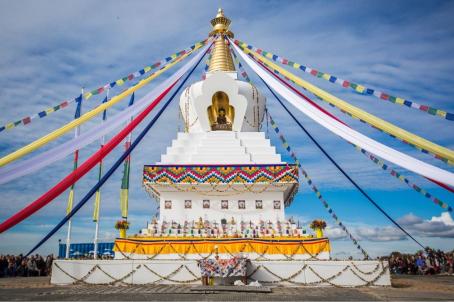
10 Buddhist stupas to discover in Europe

Stupas are symbols of enlightenment and peace that commemorate different stages of Buddha's life. Since the mid-20th century, thousands of stupas have begun to populate Europe. We have compiled some of the most impressive ones in this list.