Explore Religious Heritage Across Europe

Here you can search for a building to visit. You can use the map find destinations, or you can use the filters to search for a building based upon what different criteria.

Refine search

Reformed church

Sint Maartensbrug, NL

Building from 1696, later plastered with wooden tower on the west facade. Internally two rows of Ionic columns, wooden mirror vault. Oak pulpit, oak baptismal fence, two pews with canopy. Two copper lecterns, copper baptismal font holder, all last quarter 17th century; 17th century copper crown; tombstones. Small mechanical tower clock, 1872 (probably a Batstra clock), hook escapement with striking mechanism, electric winding. Three dials, each with one beautifully shaped hand.

Reformed church

Loenen, NL

Built in 1861 to replace the old village church. Three copper chandeliers, Louis XVI. Tombstone, 17th century. Single manual organ of Westphalian origin. Made around 1700. Placed in the Herv. Church in Loenen in 1870. On that occasion, the lower case was removed and the keyboard moved to the side. During the restoration in 1978, the case was reconstructed in its original form (with lower case and backside playing). The maker of the organ is unknown.

Reformed church

Rotterdam, NL

Built as a Reformed Church (Liberated) in the IJsselmonde district. Now in use (since when?) by Jehovah's Witnesses. Between 2014 and 2019, the Jehovah's Witnesses left this building. Today, the building is used as a mosque.

Reformed church

Lieren, NL

Extension at the rear and modification of the roof turret.

Reformed church

Langerak (ZH), NL

Brick Gothic village church with three-sided closed choir without buttresses (possibly 14th century), wide, single-nave nave with lower transept arms (16th century). The church is covered by wooden barrel vaults and was restored in 1912; the tower was restored in 1953. Inventory: pulpit (18th century); choir screen and baptismal screen (17th century); four copper chandeliers (18th century); two tombstones (17th century).

Reformed church

Puttershoek, NL

Built as a Christian Reformed Church in 1916. In use as such until 1962.

Reformed church

Stad aan 't Haringvliet, NL

Dutch Reformed Church. Single-nave, late Gothic village church with a three-sided closed choir, probably second quarter 16th century. Restored after a fire in 1898, when the original roof turret was omitted and a tower was built on the west side. Restored again in 1925-1926 and in 1980. The inventory includes: two copper crowns, 18th century, several tombstones from the 17th and 18th centuries and a copper baptismal font holder on the pulpit, 17th century. Organ case from 1901 by J. Proper.

Reformed church

Lellens, NL

NH Church on raised churchyard. Simple hall building from 1667 according to foundation stone in the south wall. Internal 17th century pulpit tub with sounding board and simple stairs; copper baptismal font. Two gentlemen's pews, circa 1700 and early 18th century, the second of which is covered. Other pews with knobs on the side pieces, organ balustrade with lectern. Number of 18th century gravestones. Large painted board with 64 Gruys-Tamminga quarter coats of arms from 1690. Cabinet organ, circa 1800 made by HH Freytag, converted into a church organ by GP Dik in 1860. Bell frame with bell by Van Bergen, 1918?, diam. 60 cm. retaining the inscription and decorations of the clock by C. Spronneaux and H. Veri, 1686. Mechanical tower clock probably 1687, decommissioned.

Reformed church

Rotterdam, NL

Built as a Reformed Church of the former village of Kralingen. Nice hall church with roof turret on the front facade.

Reformed Church

Hoornaar, NL

Single-nave, 15th century village church with a five-sided closed choir, which was extensively modified in 1842, and a monumental tower, 1555 by Cornelis Frederiks van der Goude, consisting of three brick sections with natural stone bands and slender, Ionic pilasters on the corners (the capitals of the upper pilasters were not executed).

Be inspired

Stupkalnis.lt

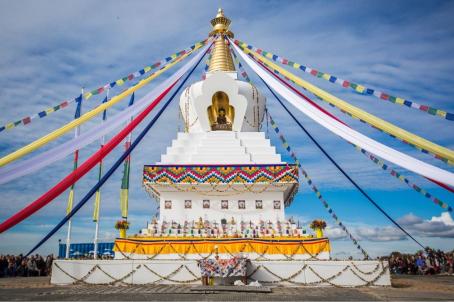
10 Buddhist stupas to discover in Europe

Stupas are symbols of enlightenment and peace that commemorate different stages of Buddha's life. Since the mid-20th century, thousands of stupas have begun to populate Europe. We have compiled some of the most impressive ones in this list.