Explore Religious Heritage Across Europe

Here you can search for a building to visit. You can use the map find destinations, or you can use the filters to search for a building based upon what different criteria.

Refine search

Hervormde Kerk

Hieslum, NL

The church stands on the site of a medieval church that was probably built around 1300. The spire is made of wood. Under the wooden floor are four gravestones of the pastors from the time before the reformation.

Hervormde Kerk

Lioessens, NL

Reformed Church. Fairly wide church, the north facade of which dates back to the 13th century, and the west facade, which was bricked up in the 20th century (1924), consists of even older tuff stone masonry. South facade Gothic, choir closure 1909. Pew, tombstones and memorial stone 1829. Bell tower with bell by Johan, 1498, diam. 90 cm. Mechanical wrought iron tower clock, 17th century?, has been decommissioned.

Hervormde Kerk

Lutjegast, NL

Reformed Church. In the church from 1877, a 17th century pulpit with Prott coat of arms on the tub; sounding board; a covered pew from the 18th century. Initially, this church housed the organ from the previous church, made in 1842 by GP Dik. The current organ from 1911, made by the Gebr. Van Oeckelen, is a gift from Udo Bronseman and Annie Hogeveen. Under the pulpit large tombstone of the Prott family. Mechanical tower clock, equipped with electric winding.

Hervormde Kerk

Noordhorn, NL

Single-nave in construction from the 13th century with a straight choir closure, in which two round-arched windows and parts of recessed panels of the top. In the side walls, there are traces of round-arched windows, entrances and a hagioscope. Strong uncut tower with high spire. In the church pulpit from 1718 with screwed columns and a sounding board. Communion table. Five gentlemen's pews, one with spindle friezes three others with knobs and richly carved rear panels, an 18th-century pew. Three 17th-century tombstones. In the tower bell from 1774. This church is listed as a National Monument of the Netherlands. On 8 November 2002, the restoration of the Dutch Reformed Church began. On Friday 16 January 2004, the church, which dates from 1280, was put back into use. It is striking that the vaults, reminiscent of the Catholic era, have been reinstalled. The gentlemen's pews, which were moved back during the 1978 restoration, are also back in their old place. Furthermore, moisture-resistant measures have been taken. The last service before the restoration was on 17 November 2002. During the restoration, church services were held in the De Wegwijzer community centre.

Hervormde Kerk

Elahuizen, NL

Dutch Reformed Church, national monument because of the single-manual organ, made in 1865 by W. Hardorff in Leeuwarden.

Hervormde Kerk

Haskerhorne, NL

In 1691 the old building was demolished, in that year a new building was put out to tender by grietman Hessel Vegelin of Claerbergen. The current pulpit probably also dates from that time, because according to experts it is from the 17th century. The appearance of the church was distinguished, so that a travelling artist Cornelis Pronk immortalized the church in 1732. The church and tower were covered with blue tiles. The building remained standing until 1915. It was demolished and a new building was built on the foundations. Money was collected for the renovation by means of subscription lists among the parishioners. After the demolition a new church was built

Hervormde Kerk

Groenekan, NL

Emergency church behind current church. Built as Reformed Federation church.

Hervormde Kerk

Siddeburen, NL

The oldest, Romanesque, part is the base of the tower and the two westernmost bays. This part was built around 1200. A few decades later, the building was extended in Romanesque Gothic style, with a recessed semicircular apse being built on the east side. The beautiful brickwork was hidden for years by a layer of plaster. Halfway through the 20th century, the church was restored, with the brickwork being made visible again. (Source: [1] )

Hervormde Kerk

Sleeuwijk, NL

The Reformed Church of Sleeuwijk has existed since 1618. For centuries, church services were held in the 'Old Church' at Kerkeinde, a few kilometres outside the village.

Hervormde Kerk

Rouveen, NL

Simple, in 1641 on the site of an older predecessor, built of brick CHURCH BUILDING, on a rectangular foundation. The tower, built in two sections, under an equally constricted slate-covered tent roof and with a sober entrance, located within a pointed arched recessed panel with a round window under a Tudor-style arch; sound holes within pointed arched recessed panels; rod anchors. The straight-closed nave, covered by a hipped roof covered with tiles, supported by buttresses with tiled offsets and provided with Tudor-style pointed arch windows in the rear and side facades; door and several small windows. The following interior elements are of interest internally: three 17th century copper crowns and a late 17th century (17th century) copper lectern. Church building with some interior elements of interest because of their architectural and art historical value.

Be inspired

Stupkalnis.lt

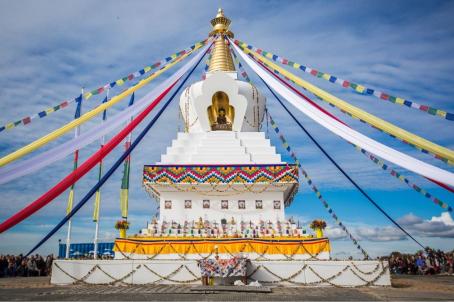
10 Buddhist stupas to discover in Europe

Stupas are symbols of enlightenment and peace that commemorate different stages of Buddha's life. Since the mid-20th century, thousands of stupas have begun to populate Europe. We have compiled some of the most impressive ones in this list.