Explore Religious Heritage Across Europe

Here you can search for a building to visit. You can use the map find destinations, or you can use the filters to search for a building based upon what different criteria.

Refine search

Hervormde Kerk

Oosterhesselen, NL

The church dates from the second half of the 15th century and was originally connected to the tower. At that time, the building had the tower, a low nave and a high choir. Around 1592, part of the nave was destroyed (siege of Coevorden). The remaining part of the nave was brought to the same height as the choir in 1628 and the west facade was then bricked up. Since then, the church and tower have been separated. Of the Gothic church, only the ruined eastern part and the freestanding tower (ca. 1450 - 1500) remain. The nave is said to have collapsed during the Eighty Years' War - or was the church never finished due to lack of money? When the church was plastered in 1862, the furniture, including two 17th century pews, remained reasonably intact. This church is listed as a National Monument of the Netherlands.

Hervormde Kerk

Hervormde Kerk

2e Exloërmond, NL

The Hervormde Kerk is a Protestant place of worship dating from 1939. Since 2002, after the Reformed Church was decommissioned in each location, it has been used as the central church of the Protestant Church in the Netherlands (PKN) in Exloërmond. The church organ was built in 1976 by the firm Gebr. Reil (Heerde).

Hervormde Kerk

Beerzerveld, NL

Expansion in 1998 with an extension at the front.

Hervormde Kerk

Herkingen, NL

The polder Oud-Herkingen was probably first diked in 1420. At that time, this polder belonged to the monastery of the Regulars of Rugge in Brielle and to the Carthusian monastery in Zelem. These monasteries rented the polder to shepherds. This polder did not exist for long. In 1484, Herkingen was diked again. On 9 July of the same year, the chapel that had been built was elevated to parish church by the bishop of Utrecht, David of Burgundy. The chapel was dedicated to Saint Cornelius and was incorporated into the monastery of the Regulars of Rugge. This polder did not exist for long either, because a flood was already reported in 1511. The chapel that had been built was probably washed away. Many floods would follow in the 16th century.

Hervormde Kerk

Hollandscheveld, NL

Dutch Reformed Church. Straight-ended neoclassical hall church, consecrated on 26 December 1850, with a facade tower with openwork lantern and constricted spire.

Hervormde Kerk

Beusichem, NL

Three-aisled pseudo-basilica with five-sided closed choir from the 15th century with a tower of which the lower four sections are still 12th century. Internal wooden barrel vaults. Replaced an older church. Beautiful tuff stone tower (ca. 1200) of the Reformed Church, raised with a brick floor in the Gothic period.

Hervormde Kerk

Belt-Schutsloot, NL

The reformed church of Belt-Schutsloot is nearing completion of a thorough renovation. Anyone who comes to view the church during the new opening on 2 February will see that the church building dating from 1925 in the reed village of Belt-Schutsloot has undergone a complete metamorphosis over the past six months. The old pews are gone, the pulpit disappeared into the container, a new consistory and an extension were built. The Beltigers, religious and non-religious, have worked together to make it happen. Marinus Lok, a retired shipwright, made a new pulpit and chairs replaced the old pews. On Sunday 2 February, churchgoers will once again face their Creator in a brand new church. The house of worship has undergone a renovation costing over 300,000 euros. The paving work began last April and in June construction workers and volunteers entered the building. The dated colours and old-fashioned furnishings made way for a fresh complexion. The churchgoers could follow the church services in the neighbouring village hall.

Hervormde Kerk

Lutjegast, NL

Reformed Church. In the church from 1877, a 17th century pulpit with Prott coat of arms on the tub; sounding board; a covered pew from the 18th century. Initially, this church housed the organ from the previous church, made in 1842 by GP Dik. The current organ from 1911, made by the Gebr. Van Oeckelen, is a gift from Udo Bronseman and Annie Hogeveen. Under the pulpit large tombstone of the Prott family. Mechanical tower clock, equipped with electric winding.

Hervormde Kerk

Hichtum, NL

Reformed Church. With its west side on the Zeilvaart on a mound, an early 13th century church building with a tower from the 16th century. Inside, behind the pulpit, a large 17th century epitaph; carved gravestone 1626. Single-manual organ, with Louis XVI case by organ builder A. van Gruisen, 1795. Bell tower with the sound of two bells, one by H. Falck, 1617, diam. 106 cm. and a modern clock. Mechanical wrought iron tower clock, 17th century, later fitted with electric winding.

Hervormde Kerk

Burgh, NL

Dutch Reformed Church. Brick building from 1678 in the shape of a Greek cross with lower side arms. After fire in 1924 and war destruction, details were changed (gutter moldings). Original furniture lost. Consistory behind a partition in the southern arm of the church. Fire-damaged remains of the marble epitaphs preserved. Inventory: remains are present of the following epitaphs: Monument Pieter de Huybert 1697 by J. Blommendaal; idem for David de Huybert approx. 1719; idem for Barbara van Willigen approx. 1719 by JP van Baurscheidt. Single-manual organ, made in 1794 by A. van Gruizen for the Reformed Church in Ee (Fr.). Placed in Burgh in 1951. The baroque organ case has carved praise with angel figures on the sides.

Be inspired

Stupkalnis.lt

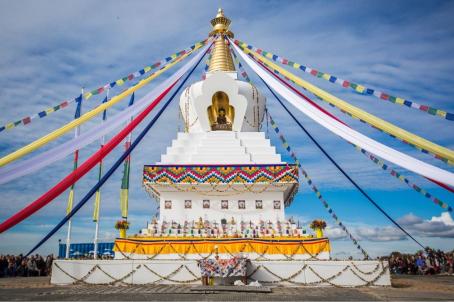
10 Buddhist stupas to discover in Europe

Stupas are symbols of enlightenment and peace that commemorate different stages of Buddha's life. Since the mid-20th century, thousands of stupas have begun to populate Europe. We have compiled some of the most impressive ones in this list.