Explore Religious Heritage Across Europe

Here you can search for a building to visit. You can use the map find destinations, or you can use the filters to search for a building based upon what different criteria.

Refine search

Heilige Jozef

Oost-Maarland, NL

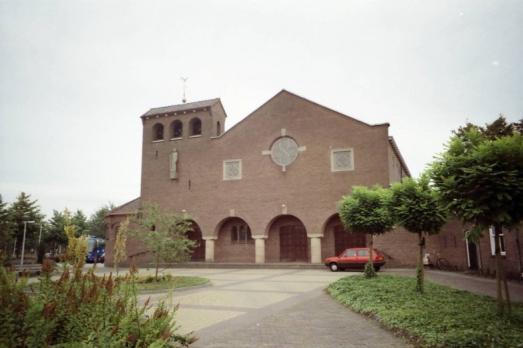
With elements of Neo-Romanesque, in 1927, to a design by architect Joseph Franssen from Roermond, a CATHOLIC CHURCH was built in honour of Saint Joseph. The architect was Johannes Duijf and the contractor was Fincken from Stevensweert. The church is connected to the adjacent rectory on the right side, and on the left and rear side is the Catholic cemetery. This church is listed as a National Monument of the Netherlands.

Heilige Jozef

Deurne, NL

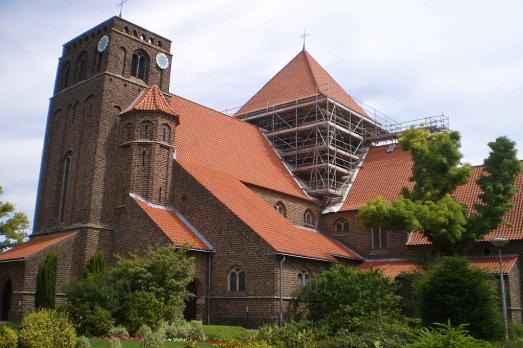
Architecturally important, striking, interbellum church, built in two phases. Extension, with among other things saddle roof tower, built in 1938. The organ was moved from the gallery, at the bottom of the tower, to the choir of the church. On the left in the hall, at the bottom of the tower, is a beautiful small Marianis, with altar, accessible daily.

Heilige Jozef

Heilige Jozef

Almelo, NL

Heilige Jozef is a Roman Catholic church built in 1953 in Almelo. It was built in the style of the Delft School.

Heilige Jozef

Heilige Jozef

Achterveld, NL

Heilige Jozef (Church of St Joseph) was built in 1933. It was designed by Hendrik W. Valk (1886-1973). It is listed as a National Monument of the Netherlands.

Heilige Jozef

Lochem, NL

The current Roman Catholic St. Joseph Church replaced a neo-Gothic church designed by AAJ Margry, which had become too small. It is a rectangular hall church with a semi-detached tower, in Bossche School style.

Heilige Jozef

Blerick, NL

The original church from 1934 was a creation of the architect A. Rats. This church was destroyed by war on 20 November 1944. The entire western part was destroyed, and the vaults collapsed. The destruction was so extensive that only the foundations were still visible. The tower clock was destroyed, as well as the harmonium, the pews and the Stations of the Cross. The bells had already been stolen by the occupier in 1942. Immediately after the liberation, the masses were read in the cellars of various parishioners. Shortly afterwards, the Custers hall was put into use for this purpose, but it was also too small. From 11 March 1945, the Lemmen hall was therefore set up as an emergency church. This burned down in 1946, so that the Custers hall had to provide a solution again. In the meantime, the Lemmen hall was renovated and purchased, so that it could be used as a permanent emergency church. This temporary church was put into use in 1958 as a nursery school, which in turn left the building in 1969.

Heilige Jozef

Delfzijl, NL

Roman Catholic parish church of St. Joseph from 1925. Replaced a smaller, nearby church from 1819, which stood at the current Johan van der Kornputplein. Crucifix basilica on a somewhat centralised plan with a wide central nave, narrow side aisles and a front tower with a spire. Sober, characteristic work in the oeuvre of the Oldenzaal architect Clemens Hardeman in the late neo-Gothic style.

Heilige Jozef

Nieuwerkerk aan den IJssel, NL

The first parish church, dating from 1898, with the rectory next to it, stood on the 's Gravenweg. This neo-Gothic church was demolished in May 1992 due to dilapidation and replaced by a new church, located on Kerklaan 20, on the site of the former town hall. After many years of preparation, this new St. Joseph's Church was solemnly consecrated and put into use on 6 November 1992 by the then Bishop of Rotterdam, Mgr. R.Ph. Bär.

Heilige Jozef

Noordwijkerhout, NL

Roman Catholic Church built in 1916. This church is listed as a National Monument of the Netherlands.

Be inspired

Stupkalnis.lt

10 Buddhist stupas to discover in Europe

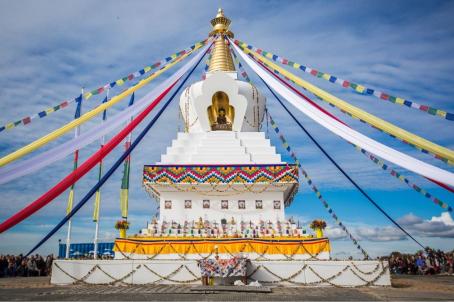
Stupas are symbols of enlightenment and peace that commemorate different stages of Buddha's life. Since the mid-20th century, thousands of stupas have begun to populate Europe. We have compiled some of the most impressive ones in this list.