Explore Religious Heritage Across Europe

Here you can search for a building to visit. You can use the map find destinations, or you can use the filters to search for a building based upon what different criteria.

Refine search

Heilige Jozef

Heeg, NL

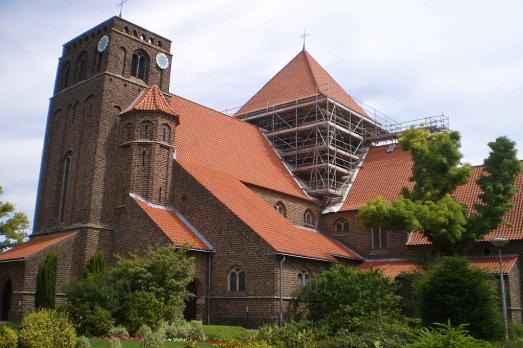
Roman Catholic St. Joseph Church from 1876. Sober single-nave neo-Gothic cruciform church with front tower. One of the seven churches that architect Pierre Cuypers built in Friesland. Interior largely from the construction period of the church. The windows were made by F. Nicolas. Single-manual organ with free-standing console from 1904, made by Joh. Hilboesen (Amsterdam).

Heilige Jozef

Nieuw-Namen, NL

Neo-Gothic church with tower. Original design by architect P. Soffers.

Heilige Jozef

Delfzijl, NL

Roman Catholic parish church of St. Joseph from 1925. Replaced a smaller, nearby church from 1819, which stood at the current Johan van der Kornputplein. Crucifix basilica on a somewhat centralised plan with a wide central nave, narrow side aisles and a front tower with a spire. Sober, characteristic work in the oeuvre of the Oldenzaal architect Clemens Hardeman in the late neo-Gothic style.

Heilige Jozef

Blerick, NL

The original church from 1934 was a creation of the architect A. Rats. This church was destroyed by war on 20 November 1944. The entire western part was destroyed, and the vaults collapsed. The destruction was so extensive that only the foundations were still visible. The tower clock was destroyed, as well as the harmonium, the pews and the Stations of the Cross. The bells had already been stolen by the occupier in 1942. Immediately after the liberation, the masses were read in the cellars of various parishioners. Shortly afterwards, the Custers hall was put into use for this purpose, but it was also too small. From 11 March 1945, the Lemmen hall was therefore set up as an emergency church. This burned down in 1946, so that the Custers hall had to provide a solution again. In the meantime, the Lemmen hall was renovated and purchased, so that it could be used as a permanent emergency church. This temporary church was put into use in 1958 as a nursery school, which in turn left the building in 1969.

Heilige Jozef

Brunssum, NL

Modern hall church without tower from 1959-1960, built at the former mining colony of Egge in Brunssum-Oost.

Heilige Jozef

Heilige Jozef

Achterveld, NL

Heilige Jozef (Church of St Joseph) was built in 1933. It was designed by Hendrik W. Valk (1886-1973). It is listed as a National Monument of the Netherlands.

Heilige Jozef

Doenrade, NL

Charming neo-Gothic village church with tower.

Heilige Jozef

Hooglanderveen, NL

During the Reformation, the Catholics in this region were served by Jesuits from Nijkerk. Services were held in 't Veen in the 'Sandhuysken'. Later, the residents of 't Veen came under Hoogland and went to church in Hoogland (an hour and a quarter's walk) or Amersfoort (no less than 1 to 2 hours' walk). Around 1853, the desirability of establishing a separate parish for this part of Hoogland and Hoevelaken was first mentioned. Due to all kinds of difficulties, the plans for a separate parish could not be realised until 1917. The population of Hooglanderveen had increased in the meantime, partly due to the construction of the railway. This increase in families also caused problems with regard to catechism education for children who had to travel far too far for this.

Heilige Jozef

Rozenburg, NL

The Roman Catholic community in Rozenburg has existed since about 1955. In the mid-fifties, there were indeed some Catholics living in Rozenburg, but they belonged to the parish of Brielle. Because Brielle was quite far away, the pastor of Maassluis was the designated pastor for the Rozenburg Catholics.

Heilige Jozef

Barger-Compascuum, NL

Important church in neo-Gothic-expressionist style, designed by Joseph Cuypers (1861 - 1949) and his son Pierre Cuypers Jr (1891 - 1982). Originally a chancel and nave with four bays, without a tower but with a roof turret on the west side.

Be inspired

Stupkalnis.lt

10 Buddhist stupas to discover in Europe

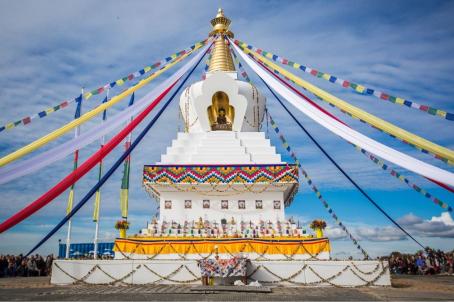
Stupas are symbols of enlightenment and peace that commemorate different stages of Buddha's life. Since the mid-20th century, thousands of stupas have begun to populate Europe. We have compiled some of the most impressive ones in this list.