Explore Religious Heritage Across Europe

Here you can search for a building to visit. You can use the map find destinations, or you can use the filters to search for a building based upon what different criteria.

Refine search

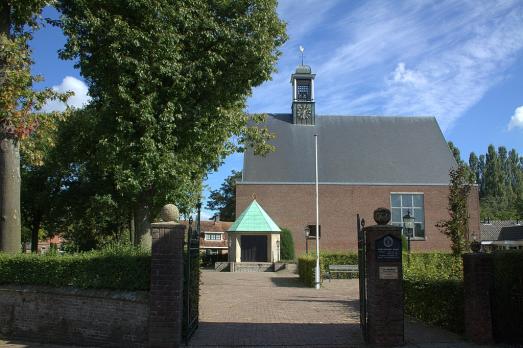
Hervormde Kerk

Nieuwkoop, NL

This church dates from 1822 and is listed as a National Monument of the Netherlands.

Hervormde Kerk

Piershil, NL

Reformed church. Rectangular hall church, after 1524, in late Gothic forms with barrel vaults and tie beams. North wing from 1643. Late Gothic tower with a decoration of arched niches, restored around 1964. The inventory includes a pulpit with lectern, baptismal font holder and baptismal fence, all second quarter 17th century. A precentor's lectern, 18th century. A lord's pew with carved coats of arms and arch panels, second quarter 17th century. A lord's pew with attachment in Louis XIV forms. Five mourning boards in carved frames, 1775, 1757, 1760, 1762 and 1794. Bell tower with chime consisting of a bell by C. and DJ Ouderogge, 1642, diam. 49 cm and a bell by J. Specht, 1753, diam. 48 cm.

Hervormde Kerk

Haaften, NL

Very interesting early neo-Gothic village church with tower. The interior of the church has been largely restored to its original state. The pulpit dating from 1834 is striking. (59-08)

Hervormde Kerk

Hervormde Kerk

Almkerk, NL

Hall church with roof turret in traditionalist forms, built in 1950 to a design by the architects Chr. Nielsen and JHC Spruit from Amsterdam to replace a medieval church that was largely destroyed in 1944. The gables are open-worked as windows. Internally visible roofing. Some mourning boards have been preserved from the old inventory, as well as the Adema organ from 1877.

Hervormde Kerk

Made, NL

The Reformed Church of Made is a late Gothic building. The church was founded in 1511 although the building has suffered several alterations in different periods.

Hervormde Kerk

Sint-Kruis, NL

In 1296, a parish in Sint Kruis was first mentioned, which was subordinate to the Ter Doest Abbey. Due to flooding, partly as a result of the Geuzen breaching the dikes in 1584 to stop the Spanish troops, the area was flooded and was not drained again until 1651. The current church building dates largely from the 14th century and initially consisted of a single-nave church with a tower. In 1467 and 1483, the church was enlarged to a three-nave church with a choir and transept. This church was badly damaged during the Dutch Revolt, but in 1652 it was restored to serve as a Reformed church building. What remained was a single-nave church with a straight-ended nave and the tower. Another renovation took place in 1872. In 1944, the church was badly damaged by war violence and was restored in 1948-1949.

Hervormde Kerk

Herkingen, NL

The polder Oud-Herkingen was probably first diked in 1420. At that time, this polder belonged to the monastery of the Regulars of Rugge in Brielle and to the Carthusian monastery in Zelem. These monasteries rented the polder to shepherds. This polder did not exist for long. In 1484, Herkingen was diked again. On 9 July of the same year, the chapel that had been built was elevated to parish church by the bishop of Utrecht, David of Burgundy. The chapel was dedicated to Saint Cornelius and was incorporated into the monastery of the Regulars of Rugge. This polder did not exist for long either, because a flood was already reported in 1511. The chapel that had been built was probably washed away. Many floods would follow in the 16th century.

Hervormde Kerk

Hollandscheveld, NL

Dutch Reformed Church. Straight-ended neoclassical hall church, consecrated on 26 December 1850, with a facade tower with openwork lantern and constricted spire.

Hervormde Kerk

Maasdam, NL

Charming, eclectic village church with tower. Built to replace its demolished predecessor .

Hervormde Kerk

Harich, NL

Reformed church and churchyard, consisting of a simple nave from 1663 at a large, partly 12th century tower, made of tuff stone at the bottom, higher up of brick; under the slates the spire also consists of brick. Above the entrance of the church on the south side memorial stone from 1663. In the church pulpit, rear bulkhead and sounding board, baptismal fence; behind the pulpit late 18th century marble tomb for UA Rengers and family. Bell tower with the sound of two bells by P. Overney, 1682 and 1683, diameters respectively: 81 cm. and 96 cm.

Be inspired

Stupkalnis.lt

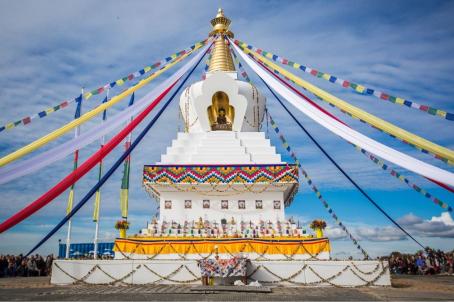
10 Buddhist stupas to discover in Europe

Stupas are symbols of enlightenment and peace that commemorate different stages of Buddha's life. Since the mid-20th century, thousands of stupas have begun to populate Europe. We have compiled some of the most impressive ones in this list.