Explore Religious Heritage Across Europe

Here you can search for a building to visit. You can use the map find destinations, or you can use the filters to search for a building based upon what different criteria.

Refine search

Hervormde Kerk

Longerhouw, NL

Church building rebuilt in the 18th century with upright tower of small yellow stone. Interior richly carved pulpit tub with rear bulkhead, sounding board; baptismal fence, all mid-18th century. Organ with main work and upper work, made in 1868 by L. van Dam and Sons. Bell tower with bell by JN Derck, 1742, diam. 95 cm.

Hervormde Kerk

Friens, NL

On a high mound, simple, three-sided closed church from 1795, internally enriched with thirteen mourning boards (1637-1843) of the Sytzama family. Against the choir wall six large carved tombstones Sytzama (1607-1759). In the churchyard seven early 19th century tombstones of the Haerama family. In the roof turret bell of anonymous founder from the 13th century, diam. 79.7 cm. Mechanical tower clock.

Hervormde Kerk

Dodewaard, NL

In a study conducted by the National Bureau for Archaeological Heritage Research, it was established that the church was built around 1050. In a deed from 1188, the parish of Dodewaard is mentioned for the first time among the goods of the Count of Dalen. In a letter from 1316, a parish church is mentioned, in which a valuable cross was said to have been located, which already enjoyed a certain fame at the time and was transferred to the collegiate church of St. Walburg in Arnhem because of the "unsafe" in Dodewaard. In this letter from 1316 by Reinald I of Gelre, Dodewaard, which had to give up its relic cross to Arnhem, is called an unsafe and unpopulated place. However, the tendency of this letter justifies doubt about the correctness of this mention. Reinald was looking for a reason to donate the cross to the newly established church in Arnhem, which he had endowed. The church of Dodewaard appears on a list of churches from 1395. In the confirmation of a donation on 16 October 1410, "the parishes of Dodewerde and Hyen" were mentioned. In 1613, the first minister, Hermannus van Broekhutzen, was confirmed "in the church service of Hien and Doyweert".

Hervormde Kerk

s-Gravenmoer, NL

Dutch Reformed Church. Since changes after destruction by the French in 1672 consisting of a three-sided closed choir of two bays, from the 15th century, two low, 15th century, shortened in the 19th century, transepts, a 15th century nave of five bays, enlarged around 1500 with a north aisle and a built-in 14th century tower with buttresses on the west side, an arched frieze under the spire and a vault over the lower space. Internal columns with molding capitals and wooden barrel vaults. Restoration completed in 1963. Oak pulpit, baptismal fence and associated copper work from 1680, replaced. 17th and 18th century tombstones. Mechanical wrought iron tower clock by Juriaan van Zutphen, 1695, electric winding.

Hervormde Kerk

Meeuwen, NL

The Reformed Church is a Reformed church building in the town of Meeuwen.

Hervormde Kerk

Iens, NL

Herv. Church and Cemetery. Picturesquely situated in the construction of a 13th century church, renovated in 1874 with the exception of a section on the north side; western saddle roof tower, in the core also still 13th century. The church contains: 17th century oak pulpit with rear bulkhead and sounding board; crowned carved coat of arms, two oak text boards. Bell tower with the sound of two bells, one of which was cast by H. Wegeaert, 1612, diam. 87.8 cm. and a modern bell.

Hervormde Kerk

Nieuw Lekkerland, NL

Large neo-church with tower. Large extension on the north side 1994 (Architect B. Bikker), which undone an earlier smaller extension from 1966-1967.

Hervormde Kerk

Paasloo, NL

Brick church from the early 16th century; modified in the 17th century. Three-aisled layout with internal wooden trusses. Single-manual organ made in 1920 by the firm P. van Dam. Bell frame with a bell by S. Butendiic, 15th century, diam. 51.5 cm.

Hervormde Kerk

Sint-Kruis, NL

In 1296, a parish in Sint Kruis was first mentioned, which was subordinate to the Ter Doest Abbey. Due to flooding, partly as a result of the Geuzen breaching the dikes in 1584 to stop the Spanish troops, the area was flooded and was not drained again until 1651. The current church building dates largely from the 14th century and initially consisted of a single-nave church with a tower. In 1467 and 1483, the church was enlarged to a three-nave church with a choir and transept. This church was badly damaged during the Dutch Revolt, but in 1652 it was restored to serve as a Reformed church building. What remained was a single-nave church with a straight-ended nave and the tower. Another renovation took place in 1872. In 1944, the church was badly damaged by war violence and was restored in 1948-1949.

Hervormde Kerk

Haamstede, NL

Reformed church. Rebuilt 16th century after fire around 1500. Crucifix church without choir with open roof turret at the crossing. In the west wall a gate with a basket-handle arch and a large closed arch window. Nave and transept of brick with sandstone corner blocks in the bears. In the basements of the walls on the south side moldings of tufa, originating from an earlier church. Nave covered by a wooden barrel vault and aisles by half-half barrel vaults. Nave separated from transept by a painted partition 19th century. Transept with high closed windows in the north and east side, roofing as in the nave. In use as a consistory and winter church. Board with the name list of ministers. Interior: fragment of a baptismal font of red sandstone. Pulpit 18th century, copper lectern. Baptismal fence 17th century with candle holder. Pew 18th century with alliance coat of arms. Two pews. Three copper crowns around 1700. Board with the name list of ministers. Interior: fragment of baptismal font of red sandstone. Pulpit 18th century, copper lectern. Baptismal fence 17th century with candle holder. Gentlemen's pew 18th century with alliance coat of arms. Two pews. Three copper crowns circa 1700. In the tower on the crosswork is the modern bell from 1950. During the Second World War, a bell from an unknown founder disappeared. A second bell, made in 1532 by Jacob Waghevens, was preserved after the war and was subsequently placed in the church. There is also said (?) to have been a bell by J. van den Ghein from 1532.

Be inspired

Stupkalnis.lt

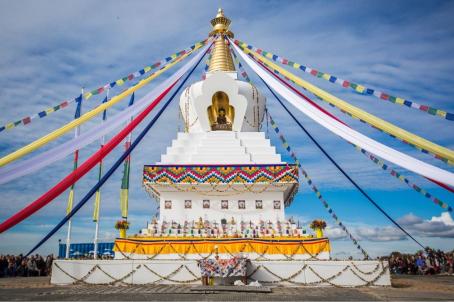
10 Buddhist stupas to discover in Europe

Stupas are symbols of enlightenment and peace that commemorate different stages of Buddha's life. Since the mid-20th century, thousands of stupas have begun to populate Europe. We have compiled some of the most impressive ones in this list.